Three exams.
One way of
thinking.
The Insider's Field Manual troubleshooting series — CCNA, ENCOR, ENARSI. Same seven-part fault anatomy, same reference codes, three altitudes.
LAB-VERIFIED CISCO CERT GUIDES · BY A 2× CCIE
Nobody fails these exams on configuration.
- Organized by how failures arrive. CCNA walks the OSI stack. ENCOR follows exam domains. ENARSI starts from the symptom you actually see at 2 a.m.
- Seven parts, every fault, every time. Symptom, Layer, First look, Root cause, Common trap, Fix, Escalate. The structure never moves — only what fills it does.
- Reference codes are stable across all three. Meet OSPF-ADJ-03 at CCNA, again at ENCOR depth, again in an ENARSI symptom fan. Same code. Three altitudes.
- Random access when it's on fire. Every manual carries a symptom index at the back — plain-language symptom, ref code, domain.
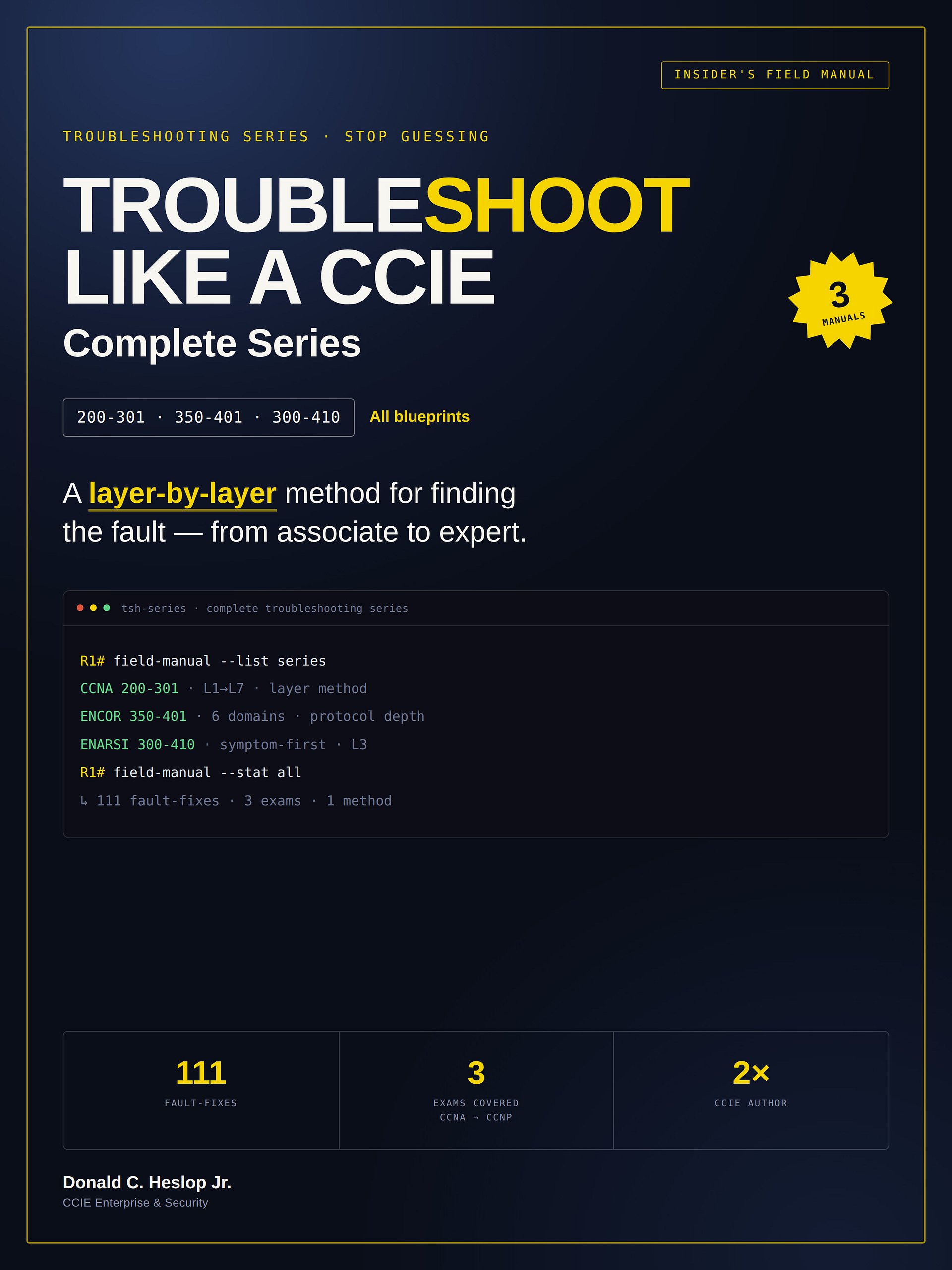
Three exams. One method. One checkout.
All three troubleshooting field manuals in a single checkout: CCNA 200-301, CCNP ENCOR 350-401, and CCNP ENARSI 300-410.
The series is built to be read as one arc. CCNA walks the OSI stack and teaches you to bisect. ENCOR reorganizes around exam domains and asks why the protocol behaves the way it does. ENARSI throws away the map entirely and starts from the symptom, the way real outages arrive.
Reference codes stay stable across all three. OSPF-ADJ-03 is the same fault at CCNA, at ENCOR, and inside an ENARSI symptom fan — same code, three altitudes. Eleven codes bridge ENCOR and ENARSI. That cross-referencing only works when you own the rungs above and below.
What you get:
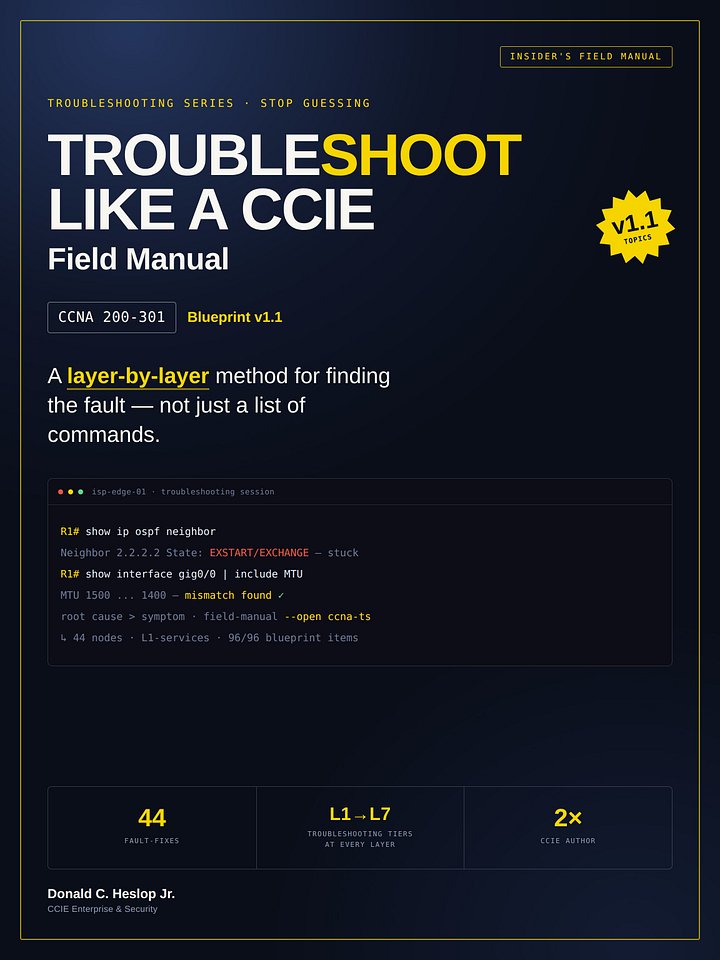
- CCNA 200-301 v1.1 — 55 pages, 28 faults
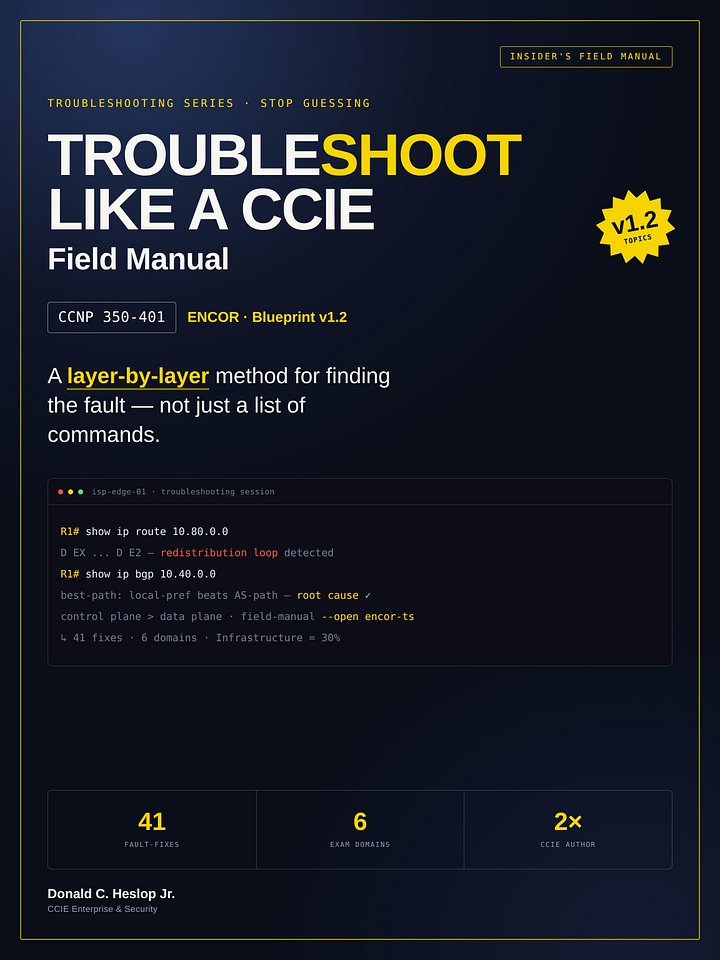
- CCNP ENCOR 350-401 v1.2 — 47 pages, 33 faults
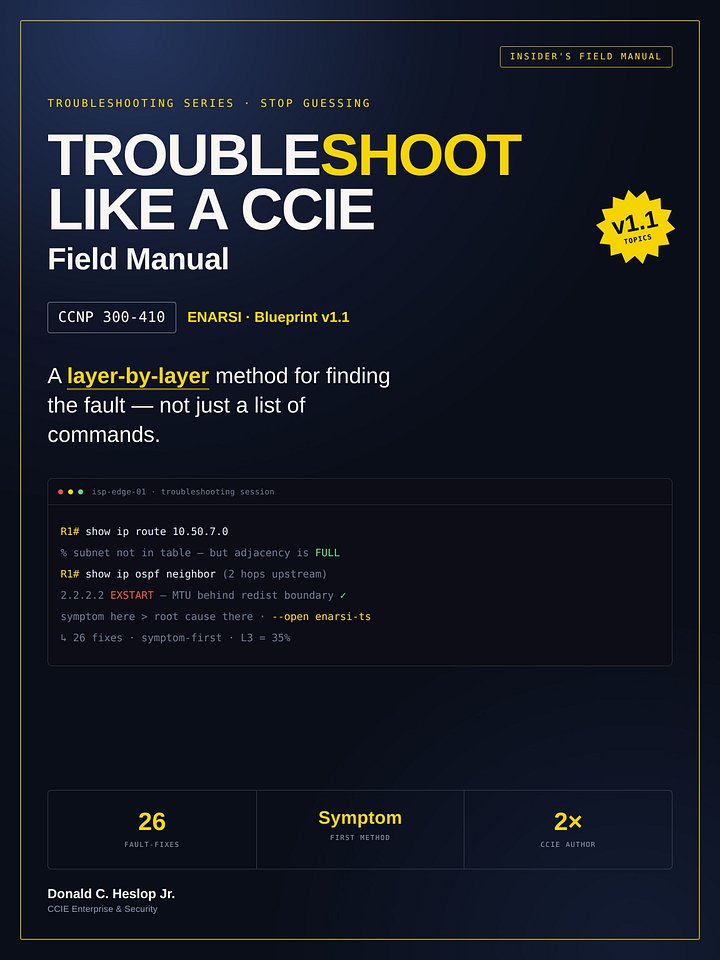
- CCNP ENARSI 300-410 v1.1 — 33 pages, 24 faults
Three PDFs, one download. Aligned to current blueprints as of 2026.
Written by
Donald C. Heslop Jr. — 2× CCIE — #61970 (Enterprise Infrastructure & Security)
Delivery & requirements
Delivered as a DRM-protected, watermarked PDF via the Locklizard Safeguard Viewer. After purchase you'll install the free viewer, register your license file, and open the guide. Your license binds to the first device you open it on; additional device licenses are available separately.
- Windows 10+, macOS 11.5+, iOS/iPadOS 15.6+, Android 6.0+
- Admin rights required for install; activation won't complete over VPN or RDP
- No Linux build available
Questions before or after purchase: support@ciscofieldmanuals.io
One fault code. Three altitudes.
This is the thing no other study guide does. Reference codes stay stable across all three manuals, so you can follow a single problem up the certification ladder and watch it get harder — not different, harder.
Every fault. Same seven parts.
The parts never change; only what fills them does. Once you've read three faults, you know where to look on every page that follows.
The exam is not the moment that tests you. The outage is.
Everyone knows the feeling. The alert fires. You open a terminal. And for a second — a second that feels much longer than it is — you don't know where to start.
Not because you don't know the protocols. You do. You've passed the labs and read the docs. But knowing a hundred commands isn't the same as knowing which one to run first, and a config you could write from memory tells you nothing about why it isn't working.
That gap — between knowing the technology and knowing how to narrow a problem — is where careers stall. It doesn't show up when things are working. It shows up at 2 a.m., in front of people.
A method closes that gap. Not more commands. A method.
- Your manager Not helping. Asking for an ETA you don't have yet.
- The application team Certain it isn't them. Waiting for you to prove it's the network.
- The engineer who's been here 20 years Watching how you narrow it. This is the part they'll remember.
- Everyone who can't work until you're done Counted in a number someone will put in a report.
Nobody remembers the engineer who knew the most commands. They remember the one who knew where to look first.
Get the complete series